

ICL Implantable Collamer Lens
An ICL is a thin, soft lens placed inside the eye, in front of your own natural lens. It corrects high minus or plus power and cylinder, so you depend less on glasses or contact lenses. Your eyes are measured first to see if it suits you.
- Suitability tested first
- The lens can be removed if needed
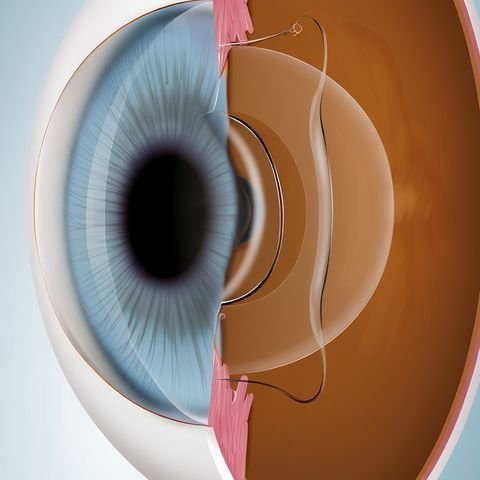
What is an ICL?
An ICL works like a contact lens that stays inside the eye. It is placed through a tiny cut, behind the coloured iris and just in front of your natural lens, where it cannot be seen or felt.
Unlike LASIK, it does not remove any tissue from the cornea. That makes it an option for people whose power is very high, or whose cornea is too thin for laser surgery.
Your natural lens stays in place. So, like anyone else, you will still need reading glasses in your forties or fifties, and you can still have cataract surgery later in life.
It may suit you if
- You are roughly 21 to 45 years old
- Your glasses power has been stable for at least a year
- Your power is high, or your cornea is too thin for LASIK
- There is enough space inside the front of your eye (measured at the check-up)
- Your eyes are otherwise healthy
- You are not pregnant or breastfeeding
How it can look
Our Patna branch, as it may look to someone with high glasses power who is not wearing glasses. Drag the handle to compare.

Tests before an ICL
-
Glasses power
Checked carefully, with and without drops, to confirm your power is stable.
-
Corneal topography and thickness
Maps the cornea, and shows whether an ICL or laser surgery suits you better.
-
Depth of the front of the eye
Measures the space where the ICL will sit. There has to be enough room.
-
Endothelial cell count
Counts the cells lining the back of the cornea, which must be healthy.
-
Retina check with drops
People with high minus power have a higher chance of retina problems, so the retina is checked too.
Types of ICL
-
Minus or plus power
ICL
Corrects high short sight (minus power) or long sight (plus power) without removing any tissue from the cornea.
-
With cylinder power
Toric ICL
Also corrects astigmatism. It is placed at a set angle, worked out from your measurements.
Ayushman card and insurance
All three branches accept the Ayushman card (PM-JAY), and cashless treatment works with most insurance TPAs. Call the branch to check what is covered for your treatment.
From check-up to surgery
-
Suitability check
A full set of measurements. Stop wearing contact lenses for some days before, as the branch advises, so the readings are accurate.
-
Your lens
Each ICL is chosen for the power and size of your eye, and may need to be ordered, which can take some time.
-
Before surgery
Some types of ICL need a tiny laser opening in the iris beforehand. The doctor will tell you if yours does.
-
Surgery day
Numbing drops, then a 15 to 30 minute procedure through a tiny cut. You stay awake but should feel no pain.
-
The next day
Your eye pressure and sight are checked. Many people see clearly within a day or two. The second eye is often done a few days to a week later.
After ICL surgery
What helps
- Use the drops exactly as prescribed.
- Do not rub the eye, and wear the shield at night for the first week.
- Keep water and soap out of the eye for about a week.
- Avoid swimming, dusty places and eye make-up for two weeks.
- Have the eye pressure and the lens checked at every follow-up, and once a year after that.
Call the branch if
- Eye pain with headache, nausea or blurred sight, which can mean high eye pressure
- Redness or discharge increases
- Your sight drops after first improving
Doctors who treat ICL
Each doctor's profile lists their training and the days they see patients at each branch.
-

Director
Dr. Reetika Sharma
Cataract, glaucoma and refractive surgery
- Patna Mon to Thu, Sat
- Hajipur Fri
Questions people ask
ICL or LASIK: which is better?
Neither is better for everyone. LASIK reshapes the cornea and suits moderate power with a healthy, thick cornea. An ICL suits higher power and thin corneas, and removes no tissue. Your test results decide.
Can the lens be removed?
Yes. An ICL can be taken out or exchanged if needed, for example when you have cataract surgery later in life.
Will I feel the lens?
No. It sits inside the eye where there are no touch nerves, and it cannot be seen from outside.
Will I still need reading glasses?
Probably, from your forties or fifties, like everyone else. The ICL corrects your glasses power, but it does not stop the natural ageing of the eye's focusing.
What are the risks?
Serious problems are uncommon. Possible risks include raised eye pressure, glare or halos at night, an early cataract and infection. The doctor will go through them with you before you decide.
This page explains ICL in general terms. The doctor who examines you will tell you what suits your eyes. Some procedures are done at one branch only, so the branch will tell you where yours takes place.
Questions about ICL?
Leave a number, we will call you
Tell us a little about the problem and which branch suits you. Someone from that branch will call you back. Email is optional.
Prefer to talk now? Call a branch directly.